07 March 2013

1907: LAUGHING GAS


Director:  Edwin S. Porter
Starring:  Bertha Regustus
Length:  8:26 minutes

   Today I’m looking at another film by Edwin S. Porter, this one called “Laughing Gas” and HOLY SHIT it actually stars a real life black person!  That was pretty damn impressive for its day, especially considering some of the movies I’ll be watching in the next couple weeks.  Sure, there had been previous films starring black actors (ahem ahem...), but for a movie in 1907 to feature a black actress in an, uhh... normal... role must have made a few monocles hit the floor.

   Unfortunately that’s about the only impressive thing about this movie.  The plot of “Laughing Gas” is so simple as to be almost nonexistent, and now that I’ve moved out of the “Oh my god did that photo just move?!” era I no longer feel bad saying that.  The film opens with the protagonist visiting the dentist’s office on account of a toothache.  The dentists put her under and pull the tooth, but they give her too much nitrous, because she spends the rest of the day stumbling around laughing like an idiot.  And everywhere she goes, her laughter proves contagious.  And boy did somebody think that was hilarious...

   First it’s the subway, where she makes the passengers enter fits of laughter.  Then she bumps into the milkman, making him laugh so hard that he drop his bottles of milk.  The bobbies show up and they start laughing too.  Then the lady and the milkman are brought before a judge, who starts laughing.  Then... you get the idea. 

   I had originally wanted to watch Georges Méliès’ “20,000 Leagues Under the Sea” for today, but I couldn’t find the full version on Youtube.  That’s very disappointing, because a movie by the famous filmagician of France would have certainly been preferable to this.  “Laughing Gas” beats its one and only joke to death longer than Seth MacFarlane performing to a laugh track on loop.  Oh well.  Next week I start getting into the feature-length pictures, which hopefully have a bit more thought put into them.

06 March 2013

1906: DREAM OF A RAREBIT FIEND

Director:  Edwin S. Porter
Starring:  Jack Brawn
Length:  5:20 minutes
    
   Ha ha, I was not expecting this one.  I figured that I should have more than one Edwin S. Porter movie on my list, since he’s hailed as such an important early filmmaker, but after the borefest that was “The Great Train Robbery”, I wasn’t expecting very much that would entertain from “Dream of a Rarebit Fiend”.  Even the title sounds dull and opaque:  the hell is a rarebit?  How does one become a fiend thereof?  This movie’s probably going to suck!, proclaimed I in my ignorance.

   Instead, what I got was a psychedelic nightmare ride with some hilarious imagery and interesting special effects.  “Dream” opens with the unnamed protagonist, at a diner, gorging himself on rarebit and beer.  Rarebit, by the way, is apparently the name of a Welsh dish made from cheese and toast (and zero rabbit).  Thoroughly wasted and stuffed, the protagonist staggers home in what is actually a pretty interesting scene.  There are two shots overlaid on each other—one is a POV shot of the camera reeling around tipsily, the other is of the drunk desperately clinging onto a street lamp post which in his disorientation seems to swing to and fro like a massive pendulum:


   Once home, he goes to bed, but his ordeal doesn’t end there.  He has a delirious nightmare in which little imps crawl out of a pot like the one he was eating out of, and prods his throbbing head with tiny pitchforks.  Then, his bed starts jumping around like an enraged bull, and leaps out of the window with the man clinging for dear life.  The shot is, I would guess, done with stop-motion, and the effect is pulled off well.  I was not expecting it, and it made me laugh.  The bed flies through the night sky over the city, as the man pilots it as though it were a motorcar (or one of those newfangled flying aero-mobiles).

   The dream ends with the man crashing through the roof of his house and landing back in bed, where he wakes to find his room as he left it:  no hole in the ceiling, no shattered window, and absolutely zero pieces of furniture possessed by Satan.

   “Dream of a Rarebit Fiend” is based on a series of comic strips which all have the same plot:  a man eats too much rarebit, has a dream where craaaazy stuff happens, and wakes up, regretting haven eaten so much rarebit.  However, the film version makes it pretty clear that it was the copious amounts of alcohol—not the rarebit—that was the cause of the protagonist’s disorientation and delirium.  I’m not even sure how just eating rarebit would give you nightmares anyway—it’s just cheese and toast.  If any of you have ever eaten Welsh rarebit, and know it to have psychotropic properties, then please do tell me.


05 March 2013

1905: RESCUED BY ROVER


Director:  Cecil Hepworth
Starring:  Blair
Length:  6:25 minutes

   1905 wasn’t a great year for movies.  I wasn’t able to find very many options for what to watch:  there was the Macedonian film “The Weavers” which, despite being the first example of Balkan filmmaking and allegedly featuring a 114-year old woman, was unavailable.  There was also “Esmeralda”, a French adaptation of Victor Hugo’s The Hunchback of Notre Dame, which might have been a fine choice.  However, I had already decided not to watch more than one movie based on the same thing for this project, and—spoilers—there’s another Hunchback adaptation I’m planning on seeing.  (More spoilers:  there’s also one instance where I’m planning to break that rule.)

   That just left the films of Cecil Hepworth, a British filmmaker who made at least two movies in 1905, according to Wikipedia.  One of them, “Baby’s Toilet”, was a three-minute film showing his infant daughter Elizabeth being given a bath.  That is pretty weaksauce—an in situ domestic scene like that might have been impressive in 1895, but this was ten years later.  Hepworth had been making movies since 1896, too, so I suppose he was just a slow learner.

   Fortunately, there’s a bit more going on in “Rescued by Rover”, his first real effort in fictional narrative.  “Rover” is about a wealthy, upper-class woman who has her infant daughter (in a returning role by Elizabeth Hepworth) kidnapped by an poor old beggar lady...  and before you get too judgmental, remember this was the post-Gilded Age, when a movie camera still cost as much as a cruise liner, and the mere thought of a wretched, lower-class untermensch getting her claws on a poor innocent babe caused your typical moviegoer to shriek in horror.

   So the kid's rich bitch—err, I mean “job creator” mother runs home and laments the kidnapping to her sister.  But luckily, the faithful family dog Rover is there to help, and runs off to find little baby Liz.  And this is where the movie gets adorable ^_^!  Rover runs all about town searching for the infant, to the assuredly-constant words of encouragement coming from the audience:  “Go get her, boy!  Go get her!  Good dog!...  Find the baby! Good dog!...”

   Rover finds the kidnapping hag in an old, run-down shantyhouse—the just rewards of her indolence, no doubt!—where she’s been keeping the baby in horrid conditions ill-befitting the child’s blue blood.  It (the dog) runs back to get reinforcements, who retrieve little baby Elizabeth and return her to the safety of her aristocratic acropolis.

   “Rescued by Rover” was the world’s first dog movie, so you owe it a great debt of gratitude if you’re a fan of “Lassie”, “Old Yeller”, “Turner & Hooch”, “Beethoven”, “Wishbone”, “Air Bud”, “Beethoven’s 2nd”, “Cop Dog”, “Air Bud: Golden Receiver”, “Homeward Bound: The Incredible Journey”, “Beethoven’s 3rd”, “Karate Dog”, “Air Bud: World Pup”, “Beethoven’s 4th”, “Air Bud: Seventh Inning Fetch”, the “Homeward Bound” remake, “Beethoven’s Big Break”, “Hotel For Dogs”, “Air Bud: Spikes Back”, “Snow Dogs”, “Beethoven’s Christmas Adventure”, “Air Buddies”, “The Dog Who Saved Christmas”, “Snow Buddies”, “Space Buddies”, or that one made-for-tv movie where Kirk Cameron and a dog exchange bodies.

   One last interesting note:  apparently this movie is responsible for the name “Rover” becoming commonplace as a dog’s name.  Before then, naming dogs “Rover” wasn’t really a Thing.  So there’s that.


04 March 2013

1904: THE IMPOSSIBLE VOYAGE

Director:  Georges Méliès
Length:  20 minutes
 
   This movie begins with an eccentric gentleman, played by director Georges Méliès, who convinces a room full of stuffy society types to join him on an improbable-sounding journey in an untested experimental vehic—wait, this is sounding familiar.  They don’t go into space in this one too, do they?  They do!?  Oh, goddammit!

   But I kid.  This is “Impossible Voyage”, Méliès’ spiritual successor to “Trip to the Moon”, based on the play of the same name by Jules Verne, and though it borrows heavily from his previous film, it’s not a rehash.  The movie opens with the aforementioned stuffy society types taking a tour of the special locomotive factory, before embarking on their journey.  The first leg of their voyage is not so impossible:  a standard train ride to Switzerland.  But after this they travel into space, flying into the mouth of the sun in a shot taken directly from “Trip”.  It’s okay, though, because they brought along a giant freezer to keep them cool!  After escaping the sun, they end up swimming a submarine through the ocean, watching jellyfish swim by, until a fire in the engine room explodes the vessel out of the sea and back to terra firma.  Along the way they manage to crash at least one vehicle on every single leg of their journey.  Again: must be a French thing.

   This movie is my favorite so far.  I love the set design—the environments are complex, colorful, and multilayered.  I believe they used painted wooden image at different depths, like a giant diorama, but it’s so seamless that it looks more like a live-action/animation hybrid, with characters even interacting with the painted images.  And the sets are not just intricate but dynamic, with rotating pistons on furnaces, steam erupting from moving locomotives in the background while characters act in the foreground, and real water flowing over a waterfall while above it a miniature train travels across a model bridge.

   I could probably write several paragraphs about how almost each and every shot has so much going on in it.  The child in me, who used to love building things with Legos and K’Nex, really wishes he could have taken part in making this movie.  The scenes are so fun to watch that it doesn’t matter at all that this movie's so similar to “Trip to the Moon”, nor that Méliès shows few signs of having borrowed from Porter’s more advanced narrative technique.  I’m gonna miss him after I don’t have any more Georges Méliès movies to watch.

03 March 2013

1903: THE GREAT TRAIN ROBBERY


Director:  Edwin S. Porter
Length:  12 minutes

   “The Great Train Robbery” is that other famous movie from the first era of motion pictures.  They always come in twos, don’t they?  Peter and Paul, Hamilton and Jefferson, Kirby and Ditko, Biggie and Tupac...  I’ve seen this called the first Western movie, but I’m not sure you couldn’t find an earlier one if you tried hard enough.  It is, however, the first movie spotlighted so far that was made in America.  Woo!  Go America!  U – S – A!  U – S – A!

   The director Edwin Porter was probably the most important American filmmaker of the 19-oughts.  Just about every research source I’m using credits him as pioneering narrative storytelling in film, and specifically “The Great Train Robbery” is cited as introducing crosscutting—cutting back and forth between two locations to portray simultaneous action.  It also pioneered the technique of matting one shot within another—the predecessor to greenscreening.  You see this during the scene on the boxcar, when the trees are visible rushing by through the window.  But I don't really get off much on the technical aspects of edition, to be honest... Plus, I can’t just keep talking about how this-movie-or-that pioneered this-or-that, or else it’s gonna get really tedious.

   The story is this:  four bandits rob some guy at a train station.  I think he might be a ticket salesman?  We don’t really have trains where I live, so I’m not sure.  The bandits catch up to the train, rob it, and get away on horseback.  But meanwhile... this is where the crosscutting comes in... the maybe-ticket-salesman is found by his daughter and freed, and he alerts a posse of vigilantes.  The posse catches up to the bandits and guns them down.  To hell with due process, mow the fuckers down!  U – S – A!  U – S – A!

   To be completely frank, this movie is awfully boring.  Yeah, yeah, I know...it’s a century old, and I shouldn’t be too judgmental, but come on!  The last movie I saw was about a colorful, phantasmagorical voyage to the moon!  It had prancing moonlings and a gargantuan cannon!  This movie has bandits, steam trains, and horses—the difference does not go unnoticed.  Also the color is gone, again... though to be fair, there is a version which adds a little color-tinting.  Why, 1940s... why must you be so far away?

02 March 2013

1902: A TRIP TO THE MOON

Director:  Georges Méliès
Length:  15:36 minutes

   Georges Méliès’ “A Trip to the Moon” is one of the most famous movies ever made, not just from the silent era but of all time.  Somehow I think I’ve known about this movie since before I even knew that silent films were ever a thing—maybe it was a Jules Verne documentary I watched as a kid or something.  The point is, everybody knows "Trip to the Moon". It doesn’t matter if you know nothing about silent movies and have no idea who D.W. Griffith, Douglas Fairbanks, or Buster Keaton are, everybody knows the image of the Moon getting shot in the eye.  And if you don’t, shame on you!

   Méliès stars as an eccentric astronomer (who IMdB tells me is named “Professor Barbenfouillis”) who tries to convince a posse of stuffy scientists (dressed like wizards) of the feasibility of his plan for traveling to the Moon:  build the world’s largest cannon, and fire a shell at it loaded with passengers.  By Denis, it’s so crazy it just might work!  He wins them over, and they’re all loaded up and shot to the Moon.

   It’s not until they crash land on the Moon, though, that things really start to get weird.  Have you ever seen that Looney Tunes short, “Dough for the Do-Do” a.k.a. “Porky in Wackyland”?  It's kinda like that, in how unadulteratedly bonkers it is.  The sky changes from the Earth rising to several scenes of space stuff while the scientists doze away.  They wake up when it starts snowing, venture into a cave where the Professor’s umbrella turns into a giant mushroom, and are met by prancing moonlings.

   These guys would be the worst emissaries for humanity ever, by the way.  For example, when the merry band of protagonists encounter their first moonling-- the very first contact with extraterrestrial life-- their first reaction is to whack it with their canes.  The moonlings don’t take kindly to this, and reinforcements come and capture the Professor and his gang, bringing him before the King of the Moonlings.  And the first thing Prof. Barbenfouillis does when they meet the King, is to run up to the throne, grab him, and throw him onto the ground.  Maybe it's a French thing.

   They finally escape from the moonlings, and return to Earth by falling off the Moon.  Yes, they fall from the Moon back to Earth.  Admit it, you would have never thought of that.

   The frame in this one is back to being cluttered, like it was in “Joan of Arc”, but fortunately the color-tinting is back as well.  If some scenes of “Joan of Arc” resembled a medieval woodcut, then the opening to “A Trip to the Moon”—featuring the interior of the astronomical society or wherever it was—reminded me of one of those lithographs showing Copernicus’ or Brahe’s laboratory.  Impossible to say what visual aesthetic influenced the lunar scenes, though... except maybe a fever dream.

   The version I watched was from a color-tinted copy recovered in 1993, which they spent carefully restoring from 1999 to 2010.  Eleven years spent to restore a fifteen-minute film... that work must have been maddeningly meticulous.  I’m glad I’m just finding out about this a couple years after it was restored, so that I don’t have to wait, and when you can watch the whole thing on Youtube.  This movie really is kind of awesome


01 March 2013

1901: FIRE!


Director:  James Williamson
Length:  4:45 minutes
   
   Before Ladder 49, before Backdraft, there was.... “Fire!”, James Williamson’s inspirational, tear-jerking, and patriotic salute to Our Brave Men And Women In The United States Fire Department... except I think it might have still just been fire brigades back then? Also I think this movie's British?  In either case, it’s a firefighter movie.

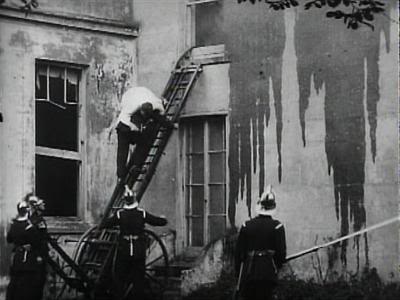
   The movie begins with a policeman finding that a building is on fire, and running to inform the local fire brigade.  The rest of the movie shows the firemen hooking their horses to their cars, getting to the house, putting out the fire and rescuing the three people inside.  It is a rather straightforward procedural, but is fairly interesting as a minidocumentary on how fire departments operated in those days;  I was joking in my first paragraph, of course—this was before the days when firemen on film rescued cats from trees.  It is of interest that the policeman who notices the fire literally runs-- on foot-- to the fire department, and that the cart containing the extendable ladder isn’t even horsedrawn, but pushed by manpower to the scene of the fire.  One wonders how long it usually took for the brigades to get to the fire in those days.  There’s also a nice scene of the two horsedrawn carts galloping down the street toward the camera on their way to the fire, which is kind of exciting.

   This movie isn’t color-tinted, (at least none of the versions I found were), but the frame isn’t as cluttered as in “Joan of Arc” so I was never confused by what was going on.  Méliès shot his movies on a set, whereas “Fire!” is filmed on-location outdoors: more open, less cramped.  The framing is more well-done, and the scenes flow into a logical progression, compared to the last film I watched.  They had the advantage that they were telling a simpler story, but I prefer to think that it was cinematography improving over time.

   The biggest problem with the movie is that, the firemen first rescue a person from the top floor by carrying them down on the ladder.  They then retract the ladder, and rescue the other person on the same floor by having him jump on a trampoline held by all of the firemen.  Maybe we are supposed to assume they didn’t know about the second person when they were withdrawing the ladder, but I think the director just wanted to show all of the gizmos the fire brigade had.